
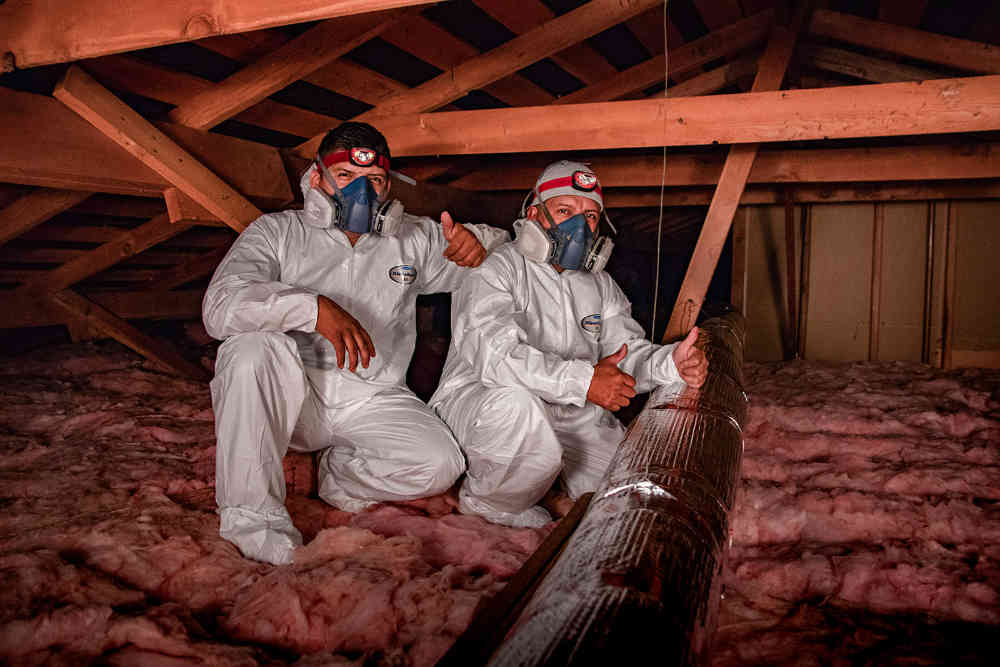
Contaminated attic insulation Oakland homeowners discover is rarely just an insulation problem — it’s a contamination problem, an energy problem, and often a rodent-entry problem wrapped into one. The insulation may be holding rodent droppings, urine, nesting material, and odor that you cannot fully see from the attic opening. That’s why adding new insulation on top never works. The contamination stays. The smell stays. The energy waste continues.
Atticare USA handles the complete restoration process: inspection, removal, cleaning and sanitizing, sealing rodent entry points, and installing new insulation. One licensed contractor. One project. One solution that actually ends with a clean, functional attic — not just an empty space waiting for the next problem.
At a glance
- Confirm the damage first — chewed tunnels, droppings, urine staining, and flattened sections signal contamination that can’t be topped up
- Understand the energy impact — damaged insulation loses R-value, driving up cooling bills in Oakland’s warmer months
- Know when topping up works — clean, merely-settled insulation can be topped up; contaminated insulation requires full replacement
- Follow the correct restoration order — inspect, remove, clean, sanitize, seal entry points, then install new insulation last
- Use one contractor for the full scope — Atticare USA handles cleanup, exclusion, and insulation so nothing gets skipped
What Contaminated Attic Insulation Actually Looks Like
Short answer: Contaminated insulation shows visible rodent damage — chewed tunnels, droppings, urine staining, nesting debris, and flattened sections. If you’re seeing any of these signs, the insulation’s thermal performance is already compromised.
Before you can decide what to do, you need to confirm what you’re looking at. Old insulation that has simply settled over 20 years is different from insulation that rodents have been living in.
In older East Bay homes — including many Oakland bungalows, Victorians, and mid-century builds — attic access can be tight, making it difficult to see the full picture from a ceiling hatch. That limited view often hides the worst of the damage.
Chewed and Tunneled Insulation
Rodents create pathways through insulation to move around the attic. You’ll see distinct tunnels carved through fiberglass batts or compressed trails through blown-in material. These pathways mean the insulation no longer provides consistent coverage — heat transfers through those gaps.
Droppings, Urine Staining, and Nesting Material
Rodent droppings look like dark pellets scattered across the insulation surface or concentrated near nesting areas. Urine staining appears as dark, damp-looking patches. Nesting material — shredded paper, fabric scraps, plant matter — indicates rodents have been actively living in the space.
The CDC recommends careful handling of rodent droppings and contaminated materials because of potential pathogen exposure, including proper ventilation and protective equipment during cleanup.¹
Flattened or Compressed Sections
Insulation works by trapping air. When rodents compress the material by nesting or traveling through it, that air-trapping structure collapses. Flattened insulation delivers a fraction of its original R-value because insulation effectiveness depends on maintaining its intended thickness and loft.²
Why Damaged Insulation Drives Up Oakland Cooling Bills
Short answer: Damaged, compressed, or contaminated insulation loses R-value — meaning heat transfers through your ceiling more easily, your HVAC runs longer, and your bills climb. The longer contaminated insulation stays, the more energy you waste.
Many Oakland homeowners notice their cooling bills creeping up without connecting it to attic condition. The connection is direct.
The Bay Area’s microclimates mean Oakland and the East Bay often run warmer than San Francisco — especially in summer months when inland temperatures climb. A poorly insulated attic means more heat radiating through your ceiling into your living space. Your air conditioner compensates by running more often. Your energy bills reflect the difference.
How Damaged Insulation Loses R-Value
R-value measures thermal resistance — how well insulation slows heat transfer. When insulation is compressed by rodent activity, torn apart by nesting, or degraded by moisture from urine, its effective R-value drops significantly. The Department of Energy notes that insulation must be properly installed and maintained to deliver its rated R-value — damage or compression undermines performance.²
The Hidden Cost of Leaving Contaminated Insulation in Place
Beyond energy waste, leaving contaminated insulation creates ongoing problems:
- Odors persist because the source material remains
- Rodents may return through unsealed entry points and nest in familiar territory
- Biological contaminants remain trapped in the material and can affect indoor air quality³
The longer you wait, the more you pay — in utility costs, in odor, and in the eventual cleanup bill.
Replace vs. Top-Up — When Each Approach Makes Sense
Short answer: Topping up works when existing insulation is clean, dry, and merely settled over time. Replacement is necessary when insulation is contaminated by rodents, damaged by moisture, or compressed by nesting activity.
This is where honest advice matters. Not every attic needs full insulation replacement. But contaminated insulation cannot be salvaged by adding material on top.
When Topping Up Works
If your insulation is clean — no rodent evidence, no moisture damage, no odor — and has simply settled from its original depth, adding new insulation on top can restore R-value cost-effectively. This works because the existing layer is still functional; it just needs more depth to meet current standards.
When Replacement Is the Only Real Fix
When rodents have nested in insulation, topped-up material won’t address:
- The droppings and urine trapped underneath
- The odor embedded in the contaminated layer
- The compressed sections that no longer insulate properly
- The potential for continued off-gassing from biological waste
You cannot sanitize through a layer of new insulation. The only path to a clean attic is removing the contaminated material first.
The 5-Step Process for Contaminated Attic Insulation Oakland Restoration
Short answer: Atticare USA’s 5-step solution addresses the problem in the correct order: inspect, remove, clean and sanitize, seal rodent entry points, then install new insulation. New insulation is always the final step — never the first shortcut.
The order matters. Here’s why each step exists and what happens during it.
Step 1 — Inspection and Assessment
Before any work begins, the attic needs a thorough inspection. This identifies:
- The extent of contamination
- Where rodents entered (gaps, vents, roofline openings, utility penetrations)
- Any damage to ducts, wiring, or structural elements
- How much insulation needs removal versus how much is salvageable
This inspection shapes the project scope and your written proposal.
Step 2 — Removal of Contaminated Insulation
Compromised insulation comes out. This includes material with visible droppings, urine staining, nesting debris, and sections that have been heavily compressed or chewed.
Removal exposes the attic floor, allowing the crew to see and address conditions that would otherwise stay buried — gaps in air sealing, damaged ducts, additional entry points.
Step 3 — Cleaning and Sanitizing
With insulation removed, the exposed attic surfaces can be properly cleaned. Debris, remaining droppings, and surface contamination are addressed. Sanitization and deodorizing help reduce odor and leave the space ready for restoration.
This step cannot be skipped. Installing new insulation over an uncleaned attic defeats the purpose of the entire project.
Step 4 — Sealing Rodent Entry Points (Exclusion)
Rodent proofing means finding and sealing the gaps, cracks, and openings that allowed entry in the first place. The EPA identifies common rodent entry points including gaps around pipes, vents, and utility lines.⁴ Common entry points include:
- Roofline gaps
- Vent openings
- Utility penetrations
- Construction gaps
Atticare USA provides exclusion — sealing entry points to prevent re-entry. This is different from trapping or extermination. If rodents are currently active in the attic, live-animal removal should happen first through a licensed pest control provider before restoration work begins.
The exclusion step is critical: a clean attic can become contaminated again within months if the path back in remains open. Atticare USA includes a 1-year warranty on rodent proofing — a one-time solution, not a recurring service contract.
Step 5 — New Insulation Installation
Only after the attic is inspected, cleaned, sanitized, and sealed does new insulation go in. Fresh fiberglass or other appropriate insulation material restores R-value and thermal performance.
Air sealing around gaps, fixtures, and penetrations may also be recommended before insulation installation. The Department of Energy recommends air sealing before adding insulation because sealing reduces uncontrolled air movement between conditioned living space and the attic.⁵
Why One Contractor Matters for This Work
Short answer: Contaminated insulation projects involve cleanup, exclusion, and insulation installation — three services often handled by separate contractors. Atticare USA does all three, eliminating coordination headaches and accountability gaps.
The Problem with Piecing Together Multiple Contractors
The typical fragmented approach:
- Hire a pest control company to trap rodents
- Hire a cleanup crew to remove insulation
- Hire an insulation installer to add new material
Each contractor handles their piece. Nobody owns the full outcome. If the insulation company installs over missed contamination, whose fault is it? If rodents return because entry points weren’t fully sealed, who’s responsible?
Scheduling alone becomes a project-management burden. One contractor delays, and the entire sequence stalls.
How Atticare USA Handles the Complete Project
Atticare USA provides the full scope: inspection, removal, cleaning, sanitizing, exclusion, and insulation installation. One licensed contractor. One timeline. One point of accountability.
This isn’t just convenient — it’s how the work should be done. The sequence matters, and having one team responsible for the entire process means nothing gets skipped or handed off incorrectly.
What Does Contaminated Insulation Removal Cost?
Short answer: Southern California project anchors run $1,500–$6,000 for contaminated insulation removal and $2.50–$4.50 per square foot for new insulation installation. Bay Area projects typically run higher due to regional cost factors.
Cost Factors That Affect Your Project
No two attics are identical. Project costs depend on:
- Attic square footage
- Severity and extent of contamination
- Accessibility (walk-up stairs vs. tight ceiling hatch)
- Type of insulation selected for replacement
- Scope of exclusion work needed
Getting a Ballpark Quote
Atticare USA provides ballpark estimates by phone to help you understand what your project might cost before scheduling an in-person inspection. You’ll receive a written proposal outlining the recommended scope of work and pricing — no hidden charges or upfront fees.
Atticare USA Serves Oakland and the Bay Area
Atticare USA’s Bay Area office is located in San Leandro, serving Oakland, the East Bay, and surrounding communities including Berkeley, Alameda, Hayward, and Fremont. The company has been helping homeowners clean, seal, and restore attics and crawl spaces since 2012.
Trust signals:
- Highly rated with 1,400+ reviews
- Helped over 11,000 clients
- Diamond Certified
- Licensed, insured, and bonded (CA License #1051462)
Before-and-after photos are available upon request. Every proposal comes with clear pricing and scope — you’ll know what’s included before any work begins.
For Oakland homeowners dealing with rodent evidence in their attic, we provide the same 5-step process that addresses contamination, entry points, and insulation in the correct order. If you’re not sure whether your attic needs full replacement or something else, our guide on whether to add insulation, remove it, or fix something else first can help you understand your options.
Frequently Asked Questions
Can I put new insulation over contaminated insulation?
No. Contamination, odor, and compressed material remain trapped underneath. Topping up only works when existing insulation is clean and undamaged.
How do I know if my insulation is contaminated vs. just old?
Look for rodent droppings, urine staining, chewed tunnels, nesting material, musty odors, or flattened sections. Old but clean insulation may have settled; contaminated insulation shows evidence of rodent activity.
Do I need pest control before attic restoration?
If rodents are actively present, live-animal removal should happen first through a licensed pest control provider. Atticare USA handles exclusion (sealing entry points), cleanup, sanitization, and restoration — not trapping or extermination.
What warranty covers the work?
Atticare USA provides a 1-year warranty on rodent proofing — a one-time solution, not a recurring service contract.
Book a Free Attic Inspection in Oakland
If you’ve seen rodent evidence in your attic — or you’re dealing with persistent odors, high cooling bills, or insulation that looks chewed and flattened — the right first step is a thorough inspection.
Atticare USA provides free attic inspections for Oakland and Bay Area homeowners. You’ll get a clear explanation of what’s actually happening in your attic, a written proposal with pricing, and a plan that addresses contamination, entry points, and insulation in the correct order.
One contractor. One project. One solution that ends with new insulation — not just an empty attic.
Schedule your free inspection today.
Keep reading
Sources
- Centers for Disease Control and Prevention. “Cleaning Up After Rodents.” CDC Healthy Pets. https://www.cdc.gov/healthy-pets/rodent-control/clean-up.html
- U.S. Department of Energy. “Insulation.” Energy Saver. https://www.energy.gov/energysaver/insulation
- U.S. Environmental Protection Agency. “Biological Contaminants and Indoor Air Quality.” Indoor Air Quality. https://www.epa.gov/indoor-air-quality-iaq/biological-contaminants-and-indoor-air-quality
- U.S. Environmental Protection Agency. “Identify and Prevent Rodent Infestations.” https://www.epa.gov/rodenticides/identify-and-prevent-rodent-infestations
- U.S. Department of Energy. “Attic Air Sealing Guide — Building America Top Innovation.” https://www.energy.gov/eere/buildings/articles/attic-air-sealing-guide-building-america-top-innovation
Serving Oakland: Atticare USA handles the exclusion side of this work locally — see attic rodent proofing in Oakland.
Recent Atticare USA projects in and near Oakland
- Attic Insulation Replacement & Rodent Proofing in Oakland, CA (Oakland, December 2025)
- Attic Insulation Removal, Cleanup & Rodent Proofing in Oakland, CA (Oakland, June 2026)
- Attic Insulation Replacement & Rodent Proofing in Oakland, CA (Oakland, September 2026)
- Attic Insulation Replacement & Rodent Proofing in Oakland, CA (Oakland, July 2026)


