When the space under your house smells musty or feels damp, crawl space cleaning followed by a vapor barrier is often the fix. AtticareUSA does that work for homeowners in Palo Alto, Mountain View, Santa Clara, Sunnyvale and Morgan Hill from our San Jose location. You do not have to start by buying a large, expensive system. Many crawl spaces need a clear-out, a clean surface, a vapor barrier and fresh insulation, done in the right order.
At a Glance
- Find the source first: the smell usually comes from old, wet or rodent-fouled insulation, debris, droppings and nesting material, or a torn or missing vapor barrier.
- Start with a free inspection: we report what is under your house before anything is removed or replaced.
- Clean before you seal: old insulation, dirt and debris come out and the surfaces are cleaned before the vapor barrier goes down.
- Seal, then insulate: rodent entry points are sealed if we find them, polyethylene sheeting is secured to the foundation walls, and new insulation goes in last.
- Get a line-item proposal: price depends on the size and condition of the space, and each service is listed with its own fee.
What Usually Makes a South Bay Crawl Space Smell Musty
Short answer: The smell usually comes from what has collected under the house. Common sources are insulation that has fallen, gotten wet or been used by rodents, dirt and debris, droppings and nesting material, and bare soil without an intact vapor barrier. An on-site inspection shows which of these are in your crawl space.
A crawl space is easy to ignore because you do not walk through it. Many Bay Area homes are older or have had additions, and the crawl space hatch can be tight or tucked away, so it goes unchecked for years. Meanwhile, insulation sags, debris piles up, rodents come and go, and the sheeting on the ground (if there is any) tears or shifts. You cannot see any of this from the living room. You can often smell it.
Old, fallen or wet insulation
Under-floor insulation sits between the floor joists. Over time, batts sag, drop onto the soil or soak up moisture. Insulation that has been squashed flat does not insulate as well as it should. Batts that are fallen, chewed, fouled by rodents or wet are usually removed rather than reused.
Dirt, debris and leftover material
Scrap lumber, cardboard, old packaging and loose material from past repairs often stay under a house long after the work is done. Debris and contaminants left in a crawl space may contribute to odors. Debris also hides the soil and the bottom of the foundation walls, so problems underneath stay out of sight.
Droppings and nesting material
Rodents use crawl spaces for shelter. In Bay Area homes, they can get in through vents, crawl space openings, utility penetrations and construction gaps. Once inside, they leave droppings, urine and nesting material in the insulation and on the ground. That is a contamination problem as much as a smell problem, and the CDC’s guidance on cleaning up after rodents calls for careful handling of droppings, urine and nesting material. Covering them with new plastic or fresh insulation leaves them in place.
A torn or missing vapor barrier
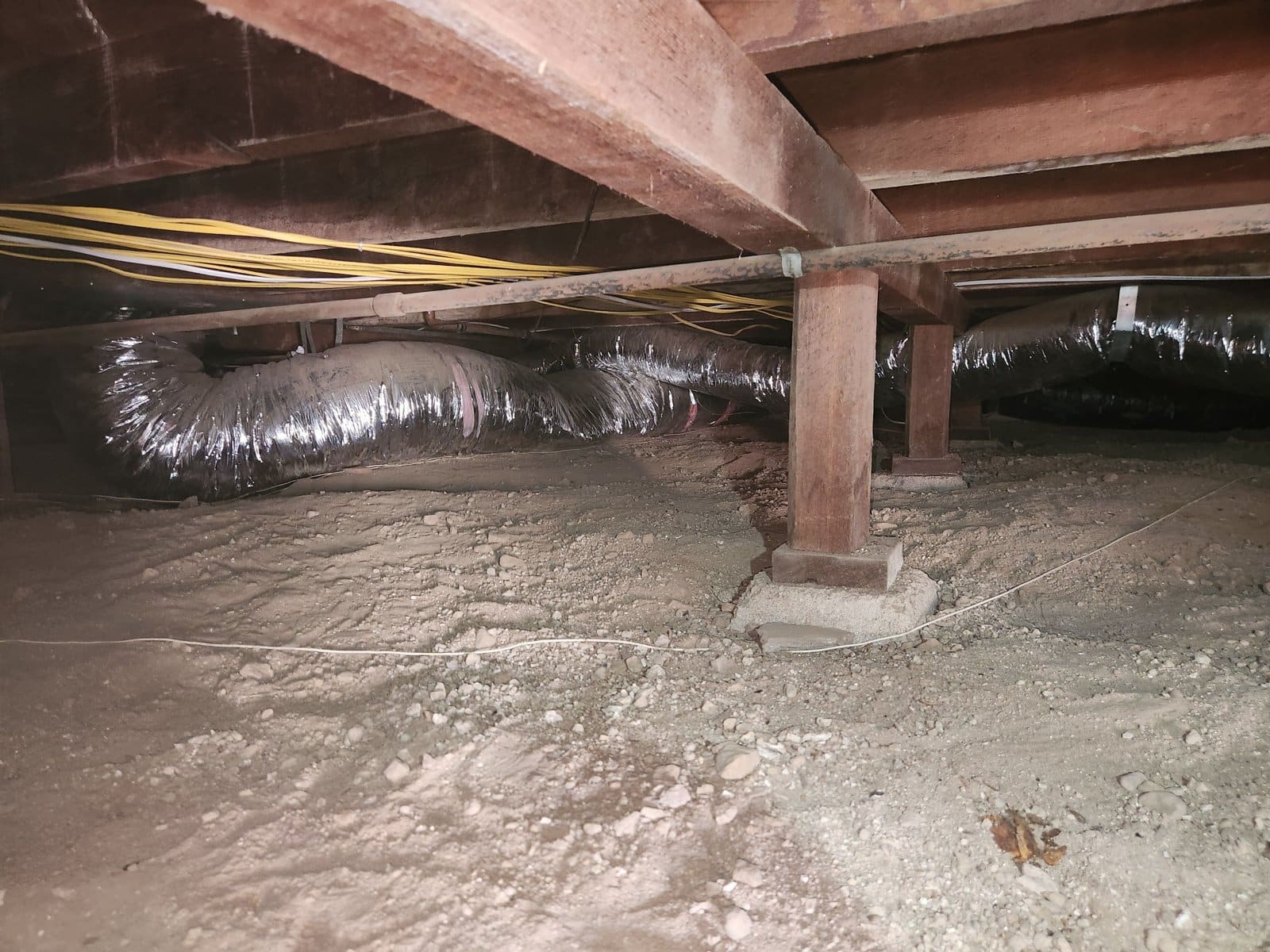
Where moisture protection is recommended, a vapor barrier covers the bare soil under the house. In many homes the original sheet has torn, bunched up or slid away from the walls. In others, there was never one at all, and the soil sits open to the crawl space air.
Each cause and the step that fixes it
- Fallen, wet or rodent-fouled insulation: removed, then replaced with new insulation where appropriate, after the space is clean and sealed.
- Dirt, debris and waste: removed, then the crawl space surfaces are cleaned.
- Droppings and nesting material: removed with the old insulation and debris, and rodent entry points sealed if the inspection finds them.
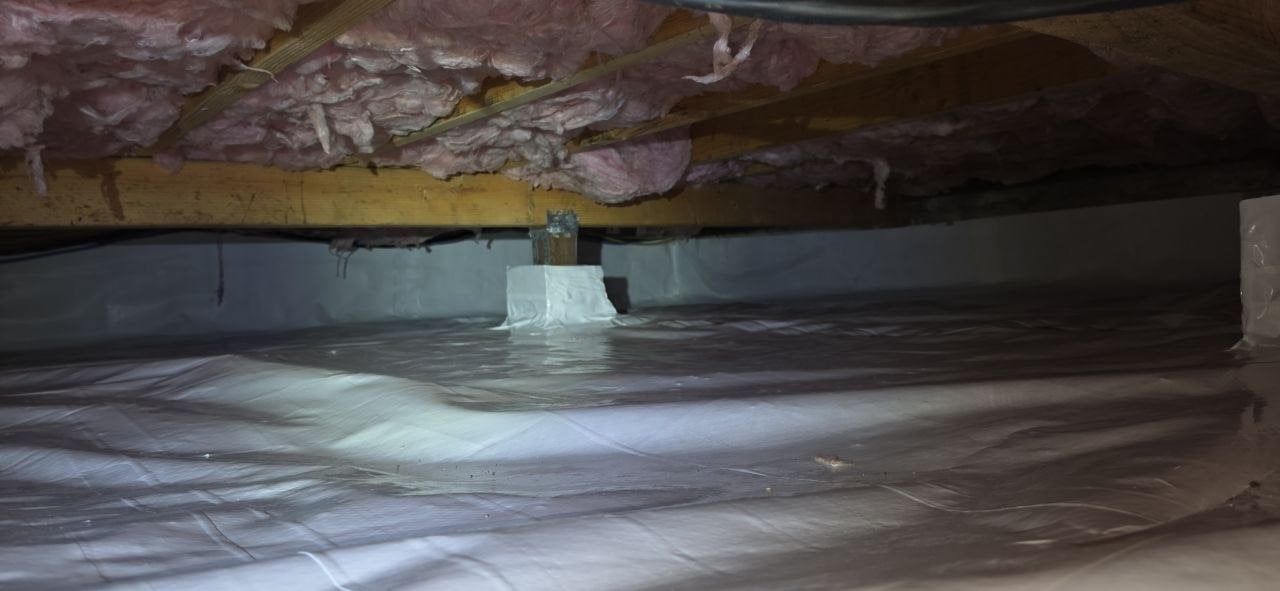
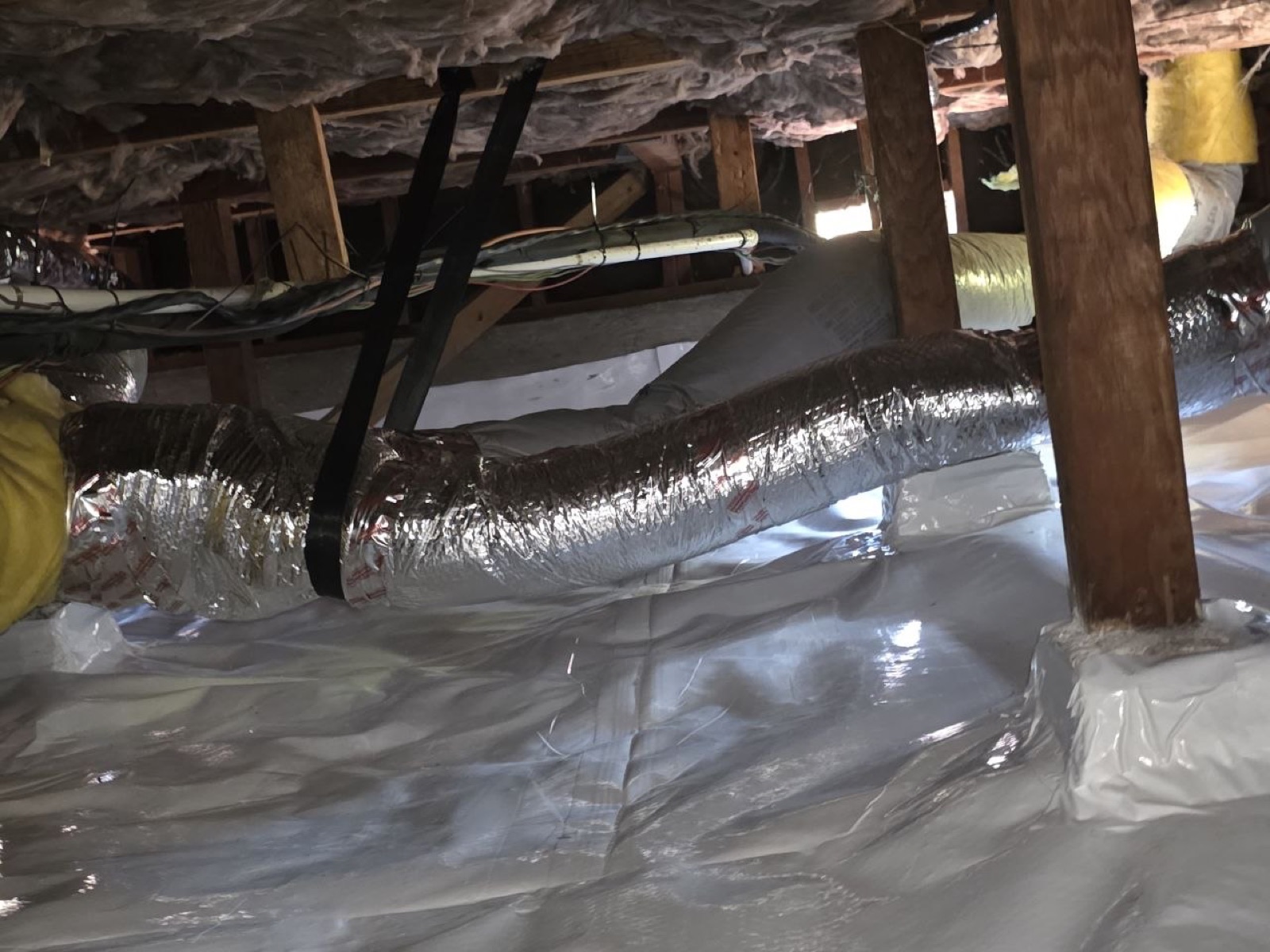
- Torn or missing vapor barrier: replaced with polyethylene sheeting along the ground, secured to the base of the foundation walls.
Most crawl spaces have more than one of these at once, which is why the fix is a sequence rather than a single product.
How Crawl Space Cleaning Works, Step by Step
Short answer: Professional crawl space cleaning follows a set order: inspect, remove, clean, seal, lay the barrier, then insulate. The order matters because each step prepares the space for the next one. A vapor barrier laid over debris traps the debris, and insulation installed before entry points are sealed is open to the next rodent.
AtticareUSA handles the cleanup, entry-point sealing, vapor barrier and new insulation as one project.
Step 1: Free inspection and findings
Our technician goes into the crawl space and looks at what is actually there: the condition of the insulation, debris, droppings and nesting material, possible rodent entry points, the state of any existing vapor barrier, and signs of moisture. We use a thermal imaging camera to find drafts and heat loss in attics and crawl spaces, and the inspection checks how well your existing insulation is working. You can read more about our thermal imaging crawl space inspections.
We report the findings to you, explain which steps your crawl space needs, and work out the approach with you. That way you are not paying for work the space does not call for. Our estimator also takes measurements on site, because price depends partly on the square footage of the crawl space.
Step 2: Removing old insulation, dirt, debris and waste
Our crew takes out insulation that has fallen, gotten wet, been chewed or been fouled by rodents, along with dirt, debris and undesirable waste. Droppings and nesting material come out with it. Because this is messy work, we protect the work area and the access path through your home, and we leave the job site clean.
Removal is also what makes the rest of the job possible. With the old material gone, we can see the soil, the framing and the base of the foundation walls clearly.
Step 3: Surface cleaning of the crawl space
Once the bulk material is out, we clean the crawl space surfaces. This step matters because the vapor barrier and the new insulation should go into a clean space, not on top of what was left behind.
Step 4: Rodent proofing, if entry points are found
If the inspection found places where rodents are getting in, we can seal them as an optional part of the job. Our rodent proofing is pesticide-free: entry points are sealed with wire mesh, polyurethane foam and cement as needed. Sealing entry points helps reduce the chance of future rodent entry, and our rodent proofing carries a 1-year warranty. More detail is on our rodent proofing in the Bay Area page.
We do not trap or remove live rodents. If rodents are still active, a licensed pest control provider removes them first, and then we do the cleanup, entry-point sealing and insulation.
Step 5: Laying the vapor barrier
We lay polyethylene sheeting along the ground and secure it to the base of the foundation walls. The barrier goes in after removal and cleaning, because sealing a crawl space that still holds old insulation, dirt and debris locks the problem in. See our crawl space vapor barrier installation page for the Bay Area.
Step 6: New insulation where appropriate
New insulation goes in last, after cleanup and sealing. Installed in a clean, sealed crawl space, insulation can support comfort and energy efficiency in the rooms above. We install crawl space insulation when the inspection shows it is appropriate, not by default.
What a Vapor Barrier Does, and Why Cleaning Comes First
Short answer: A crawl space vapor barrier is a polyethylene sheet laid over the soil and secured to the base of the foundation walls to protect the crawl space from ground moisture. It does not clean anything, which is why the old insulation, debris and droppings come out before it goes down.
Think of the barrier as a lid on the dirt. Without it, the soil under your house is open to the air in the crawl space. With an intact sheet that reaches the walls, that path is covered.
Two things decide whether a barrier does its job:
- What is under it. Plastic laid over fallen insulation, scrap wood and droppings traps all of it, smell included, under the sheet. That is why removal and cleaning come first.
- How it is fastened. A sheet that stops short of the walls, or that has slid away from them, leaves gaps. Securing the sheeting to the base of the foundation walls keeps the ground covered edge to edge.
Not every crawl space needs a new barrier. AtticareUSA installs vapor barriers in crawl spaces where moisture protection is recommended, and the inspection tells you whether yours is one of them. For more background, see our overview of crawl space vapor barriers.
Serving Palo Alto, Mountain View, Santa Clara, Sunnyvale and Morgan Hill from San Jose
Short answer: AtticareUSA serves all five cities from our San Jose location at 900 E Hamilton Ave., San Jose, CA 95008. We serve San Francisco and the rest of the Bay Area from offices in San Leandro, San Jose, San Rafael and Petaluma, and we have been in business since 2012.
Every city gets the same process: a free inspection, a clear report of what we found, and a transparent proposal that lists each service and its price separately. Your house sets the scope, not your ZIP code.
Palo Alto and Mountain View
Homes in Palo Alto and Mountain View, and in nearby Los Altos and Menlo Park, are worth a look under the floor. Only an inspection shows what your own crawl space needs, because two houses on the same street can look very different underneath. In older homes, the insulation and any sheeting under the floor may have been in place for a long time, and that alone is worth a look.
Sunnyvale and Santa Clara
In Sunnyvale, Santa Clara and neighboring Cupertino and Campbell, common reasons to look under the house are a musty smell in the rooms above the crawl space, floors that feel colder than they should, signs of rodents, or simply not knowing what is under a house you recently bought. Comfort can also vary from one South Bay microclimate to the next. Each of those calls starts the same way, with an inspection that shows what is actually there before anything is removed or replaced.
Morgan Hill
We cover Morgan Hill from the same San Jose location, along with nearby San Martin and Gilroy, with the same free inspection and the same step-by-step job. You do not need a separate company for the southern end of the county.
Just Bought a Home in Sunnyvale? Have the Crawl Space Inspected
Short answer: If you just moved into a Sunnyvale home and the crawl space smells musty or damp, call AtticareUSA for a free inspection. You will learn what is under the house, whether the insulation and vapor barrier are doing their job, and whether rodents have been getting in, before you decide what to fix.
Buying a house means a lot of paperwork and very little time in the crawl space. Many new owners open the hatch for the first time weeks after closing and catch the smell. That is a good moment to have the space looked at, ideally before winter, so you have a clear starting point for the home you now own.
While our technician is at the house, ask about the attic too. Many new owners have never seen theirs either. We inspect attics for rodent activity, possible entry points and insulation condition, and that inspection is free as well.
Recent AtticareUSA Projects in Palo Alto, San Jose, Sunnyvale and Saratoga
These are real jobs our crews completed nearby. Each project page has the details and photos from the job.
- Palo Alto, CA (September 2026): crawl space cleanup, rodent proofing and new R-19 faced fiberglass batt insulation across 1,500 sq ft.
- San Jose, CA (November 2025): crawl space cleanup, a new vapor barrier and R-19 fiberglass batt insulation across 1,500 sq ft.
- Sunnyvale, CA (July 2026): crawl space cleanup, a new vapor barrier and R-19 faced fiberglass batt insulation across 950 sq ft, plus a radiant barrier.
- Saratoga, CA (August 2026): attic and crawl space cleanup with whole-house rodent proofing.
Frequently Asked Questions
Why does my crawl space smell musty?
The most common sources are old or fallen insulation, debris such as scrap wood and cardboard, rodent droppings and nesting material, and bare soil without an intact vapor barrier. Often it is a combination. An inspection tells you which ones are under your home.
Do I need a vapor barrier?
Not every crawl space does. A vapor barrier makes sense where moisture protection is recommended, and the inspection will show whether your crawl space has no barrier, a torn one, or one that has pulled away from the walls. When one is needed, AtticareUSA lays polyethylene sheeting along the ground and secures it to the base of the foundation walls after the space is cleaned.
Which companies handle crawl space cleaning and moisture problems in Palo Alto and Mountain View?
AtticareUSA does crawl space cleaning and vapor barrier installation in Palo Alto and Mountain View from our San Jose location. The job covers inspection and findings, removal of old insulation, dirt and debris, surface cleaning, rodent proofing when entry points are found, a polyethylene vapor barrier, and new insulation where appropriate.
Which Santa Clara and Morgan Hill companies clean crawl spaces and install vapor barriers?
AtticareUSA serves both Santa Clara and Morgan Hill from San Jose. We are licensed, insured and bonded (CA #1051462), Diamond Certified, BPI-certified, and highly rated with 1400+ reviews.
We just moved into a Sunnyvale home and the crawl space smells musty and damp. Which company should I call to inspect and clean it?
Call AtticareUSA for a free crawl space inspection. Our technician checks the insulation, debris, rodent signs, possible entry points and the condition of any vapor barrier, and reports the findings to you. You then get a proposal with each service priced separately, and we clean, seal and reinsulate the space as the findings call for.
What if there’s standing water under the house?
Standing water or leaks after rain need a drainage fix first. The inspection will tell you if that’s the case, and once the water is handled, AtticareUSA cleans, seals and reinsulates the space.
Should crawl space insulation be replaced?
It depends on its condition. Insulation that has fallen, been chewed, been fouled by rodents or gotten wet is usually removed. Wet insulation is replaced only after the moisture source is fixed, and new insulation goes in last, after the space is cleaned and sealed.
How is the price for the job set?
Prices depend on the size and condition of the crawl space and on any added issues you choose to fix, such as rodent proofing or new insulation. Our estimator takes measurements on site, and the proposal comes by email with exact prices and service details. Each service is listed with its own fee, with no hidden charges or upfront fees.
Schedule a Free Crawl Space Inspection in the South Bay
Short answer: Contact AtticareUSA to schedule a free crawl space estimate for your home in Palo Alto, Mountain View, Santa Clara, Sunnyvale or Morgan Hill. Our technician inspects the space and reports what is there, and you receive a proposal that prices each service separately.
You do not have to guess what is under your house or commit to a large system before anyone has looked. AtticareUSA has been in business since 2012 and has helped over 11,000 clients. We are licensed, insured and bonded (CA #1051462), Diamond Certified and BPI-certified. Our crews take before-and-after photos on the job, and they are available upon request.
If you want to read more about the service first, see our page on crawl space cleaning in the Bay Area. When you are ready, contact us to book a free inspection and understand what is happening under your home.
Sources
- ENERGY STAR, “Recommended Home Insulation R-Values”: https://www.energystar.gov/saveathome/seal_insulate/identify-problems-you-want-fix/diy-checks-inspections/insulation-r-values
- Centers for Disease Control and Prevention: Cleaning Up After Rodents. https://www.cdc.gov/healthy-pets/rodent-control/clean-up.html